
Overview#
Welcome to the documentation of the the MaxLab Live Application Programming Interface (API). The API offers capabilities that extend beyond the functionalities of the standard MaxWell Assays. While Assays are designed for standardized experiments, the API provides higher flexibility and more customization options for advanced experimental designs and integrations with external resources.
Introduction#
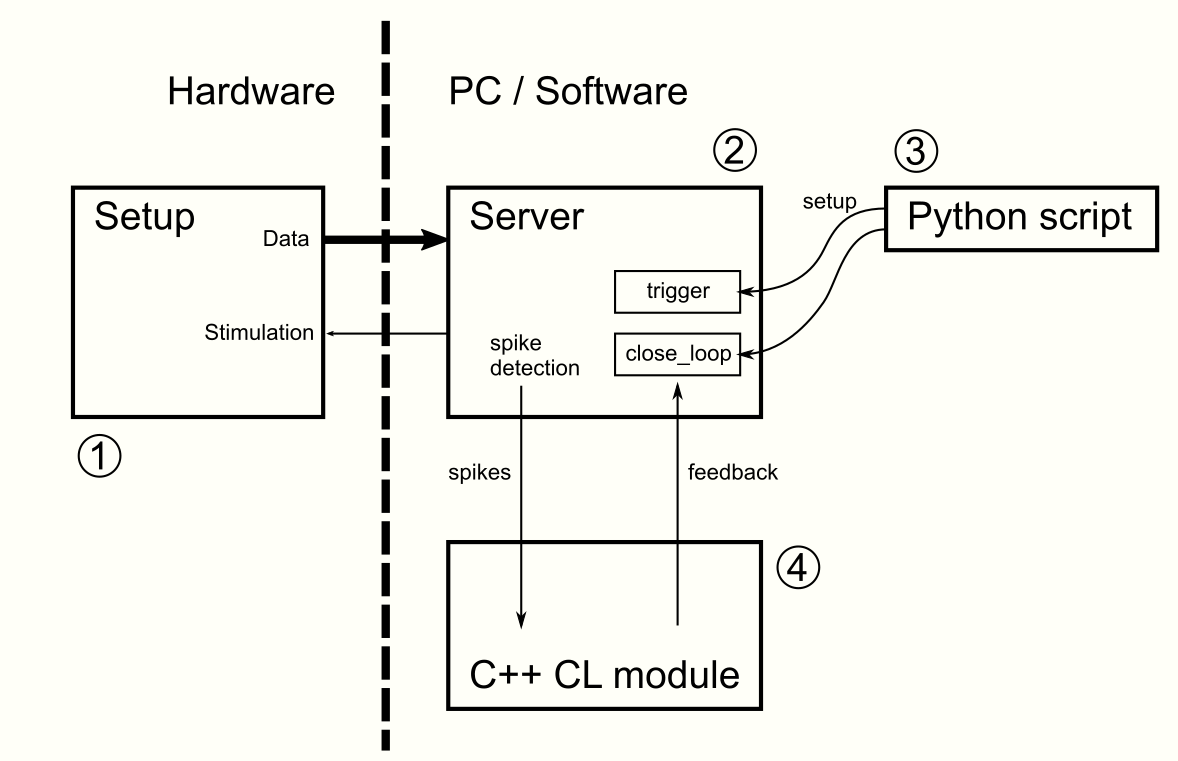
The API consists of a Python and C++ interface, which have different yet related uses.
This Python interface enables you to:
operate the MaxOne and the MaxTwo,
prepare the devices for experiments,
start and stop recordings,
and create stimulation sequences that can be used during recordings,
according to your own needs for custom experiments.
The C++ interface allows you to:
monitor the incoming data stream,
swiftly deliver responses based on predefined conditions,
concurrently read and transmit on two separate ports,
and thereby enables closed-loop approaches.
An overview of the interaction between the hardware, server and the two interfaces can be seen below.
Guide to this documentation#
The API-Documentation consists of five sections:
- Tutorial:
A comprehensive tutorial that will walk you through the essential functions of the API module. This is the best place to get started.
- API:
A detailed documentation of the Python and C++ interfaces.
- FAQ:
Answers to the most common questions about the MaxLab API.
- Examples:
Example scripts for common use-cases. Try to run these scripts to gain hands-on experience with the API.
- Glossary:
Explanations for commonly used technical terms.
Note
The MaxLab Live API primarily operates in Python, which is essential for all open-loop applications. For users looking to extend functionality to closed-loop applications, knowledge of C++ is required. Proficiency in these programming languages is essential for customizing experiments, developing specialized scripts, and fully utilizing the API’s capabilities.